

Burkina Faso: An interview about the situation in the country
Largely unnoticed by the international community, violence, displacement, and forced migration in Burkina Faso have reached alarming proportions: For more than six years, the country has been in the crosshairs of jihadist terror, which is also raging in Mali and Niger. Marti Gensel, co-financing officer for Africa at Terre des Hommes , was on the ground and reports on the conflict, the situation of the displaced children, and the work of Terre des Hommes .
Who is fighting whom in Burkina Faso and why?
The situation is highly complex, involving numerous actors: Groups affiliated with the terrorist network al-Qaeda and the Islamic State, which until 2019 partially cooperated, are now fighting each other. Local militias, armed volunteer groups, police, military, and security forces support the government, which changed hands twice last year alone through military coups. The objectives in the individual regional conflicts are not always clearly defined; they often involve not only religious ideologies but also the conquest of territory, control of economic activity, and the deliberate creation of political instability. However, the breeding ground for all of this lies in much deeper, more profound problems such as poverty, a lack of social services, and the state's neglect of the rural population, which has led to widespread public discontent.
Why do so many young people join these groups?
Certainly, very few do this out of ideological conviction. Besides intimidation and direct coercion, many of these mostly marginalized young men lack an alternative: there are no educational opportunities and no sources of income. In this context, participation in an armed group can be perceived as a viable option.
Is the whole country affected by the violence?
Indirectly, yes, although it is comparatively safer around the capital, Ouagadougou, and in the south of the country. In many other regions, attacks occur regularly, villages are looted, or fighting breaks out. The north and east are currently inaccessible to us, and there is no sign of the situation stabilizing.
But people still live there…
Yes, but there are virtually no government structures left, and therefore no security. The armed groups establish their own jurisdiction. If you oppose their rules, you'll be seen as an ally of rival groups or the state. This can have dire consequences. People are faced with a choice: submit to these imposed rules or flee. On the other hand, control by an armed group can initially mean that a village experiences no more fighting and a period of relative peace.
Burkina Faso has a population of 22 million; are many of them refugees?
Nearly two million people have officially fled their home region, most of them women and children. The actual number is likely even higher: No internally displaced persons are registered in the capital, but the reality is quite different.
"People are faced with a choice: Do I submit to these imposed rules or do I flee?"
How do they make a living?
In Burkina Faso, not only refugees but three to four million people are living in acute food insecurity. Many help in agriculture or livestock farming, engage in informal trade, or work in casual labor. Many are nevertheless dependent on humanitarian aid, and some are supported by relatives or acquaintances. Some communities have taken in two to three times their original population of refugees. This has had an enormous impact on infrastructure, such as health centers and their staff. In many places, there is a lack of sufficient drinking water sources and sanitation facilities.
How are the children and young people doing? Are there enough schools?
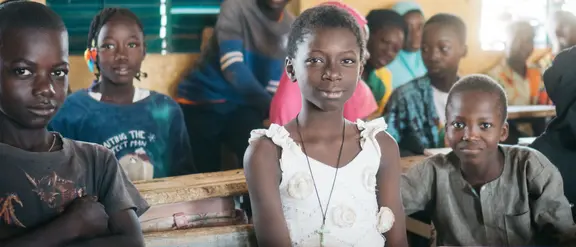
The classes in the receiving schools sometimes have well over 100 students. Equipment is often makeshift, and lessons are sometimes held outdoors. Added to this are language problems: the refugee children often understand neither the official national language, French, nor the local language of their host community, as Burkina Faso has many different local languages.
What benefits does such school instruction offer children?
Although the quality of education may not be the best due to the circumstances described, the children find a safe space at school. They can interact with peers, develop a sense of belonging, and experience a degree of normalcy.
How does Terre des Hommes help?
For example, we offer integration classes for refugee children or children from the host communities who have not previously attended school. Currently, more than 2,000 children are enrolled in these courses. They last nine months and take place outside of regular school hours. Among other things, the children learn French there. Our partner organizations are also improving school facilities, providing blackboards, chairs, tables, and learning materials. At the same time, we are working with teachers to teach them how to interact with refugee children so that they are better integrated and conflicts between refugees and locals are avoided.
Terre des Hommes therefore takes care of the education of children…
For their education and protection: The difficult situation of families is far too often a breeding ground for violence and violations of children's rights. Our partner organizations are establishing protection committees in around 30 communities, which will take action when someone witnesses violations of children's rights.
What specific violations of children's rights are we talking about?
Examples include female genital mutilation, exploitative child labor, neglect, physical or psychological violence against young women or girls, and recruitment by armed groups. In many of these cases, the safeguarding committees can act as a first point of contact. The case is filed there and then forwarded to the relevant authorities. They also work to prevent such violations through education and early intervention. They are supported by children's and youth clubs that educate about children's rights and their violation.
What impressed you most on your trip?
Many things, but above all the incredible willingness to help shown by the people in the host communities. They themselves face challenging circumstances, yet their readiness to help refugees is enormous. There are hardly any conflicts; the situation is somehow managed together. I was also impressed by the overwhelming gratitude for our work and the work of our partner organizations. The need in almost every area is immense.
Please help with a donation