

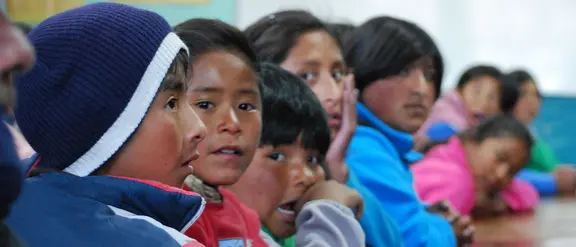
Working children fight for their rights
The "man-eating mountain" is the name given to Cerro Rico in Potosí, Bolivia – a symbol of the exploitation of Latin America's indigenous peoples. Tens of thousands died mining silver and tin for the Spanish colonial rulers. "It's worth a Potosí" has become a common saying to express the great value of something. And for many, Cerro Rico still represents a promise of wealth. Numerous mining cooperatives blast their way into the mountain unchecked and uncoordinated; young people still work and die in the inadequately secured shafts. The mountain is so riddled with holes that in 2011 a 700-square-meter crater opened on its summit, which had to be filled with concrete.
Today, social worker Luz from Terre des Hommes partner organization PASOCAP (Pastoral Social Cáritas Potosí) came up the mountain. The air is thin at over 4,000 meters altitude, and it's dusty. Two boys are playing with a spinning top in front of a mine. Luz learns that although they don't work in the mines, they earn money by guarding the mine entrance. They are exercising their right to education: they both attend school. Luz tells the two children about PASOCAP's services. "There are recreational activities, a theater group, homework help, meals, and counseling services for working children," she explains. She adds that the bakery at the NATs-Pasocap center also offers an opportunity to earn money and receive training that is much safer than working in the mine. She invites the two boys to come and check out PASOCAP's open meetings.
A right to decent work
Today, 30 young trade unionists are meeting at the PASOCAP center to discuss the situation of working children in Bolivia. It's a complex issue: Until 2014, child labor was completely banned in Bolivia. Despite this, the number of working children was and remains very high. An estimated one million children between the ages of five and 17 work in Bolivia, representing almost 9 percent of the total population. Exploitative child labor isn't limited to the mines; many children work as street vendors, shoe shiners, bricklayers, or in restaurants, for example.
But those who work illegally cannot defend themselves against exploitation and have no right to social benefits or a minimum wage. That's why thousands of children, organized in child unions, campaigned for a law that would legalize child labor in exceptional cases. Dangerous activities like working in mines should remain prohibited; instead, children should be given safe, supervised jobs with workers' rights, allowing them time for school and leisure and bringing them out of illegality.
The law was passed by parliament in 2014, but in 2017, under pressure particularly from the International Labour Organization (ILO), Bolivia's highest court declared it unconstitutional. Working children in Bolivia are furious about this, and even more so because the ILO refuses to listen to their concerns despite numerous requests. "They will continue to work on the streets because it's a matter of survival," explains Luz. "And it doesn't matter if there are 1,000 laws prohibiting child labor. They are fighting for their right to decent work.".
A place to be a child
It's Saturday, and the NATs-PASOCAP center is bustling with activity. The smell of fresh baked goods fills the air, and people are queuing outside the center to get a bag of still-warm rolls. Inside the bakery, the young people from the project bake and sell the goods. They run and manage the business independently, meticulously accounting and recording all transactions. Everything sells out quickly.
In the hall, children from the theater group dart back and forth, gathering their props and costumes, the older children helping the younger ones. Social worker Luz is everywhere at once. She supports the children during the theater rehearsal, talks to them about family and work problems, offers concrete assistance, or simply provides a shoulder to cry on.
Then the performance begins. The play, developed by the children and teenagers, deals with domestic violence and manages to present this serious topic in an entertaining way, accompanied by plenty of music and dance. The children who aren't on stage themselves sit spellbound in their seats, eagerly following along and shouting out tips to the actors. Those who can't stay indoors play football outside.
Despite positive economic development, poverty in Bolivia remains so widespread that, for the foreseeable future, children will continue to work alongside their schooling, despite a ban. They do this to ensure their survival, but also to fulfill their dreams: finishing school, attending university, or starting a business. At the PASOCAP center, they can always find a safe space where they receive support with their schooling, learn about their rights, and make plans for their future. But they can also be carefree, play, laugh, and forget their worries.
Your support for strong children!