

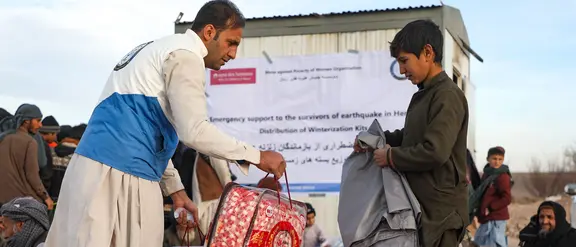
In acute emergencies caused by natural disasters, wars, or armed conflicts, Terre des Hommes helps children and their families. Support us in our emergency disaster relief and long-term reconstruction efforts.
Your donation helps!
Projects


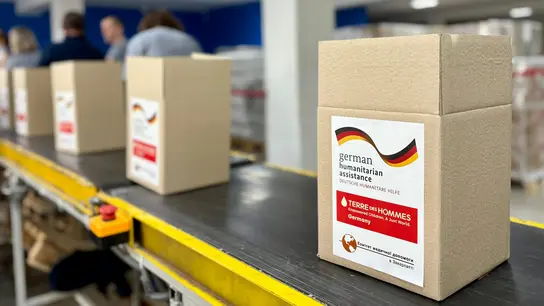
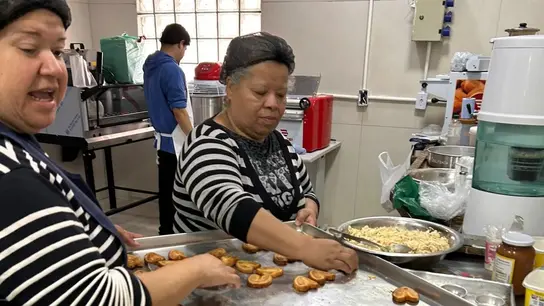
Ensuring survival
Natural disasters, wars, and armed conflicts trigger acute emergencies. Terre des Hommes in partnership with local organizations, helps children and their families: Together, we ensure rapid, needs-based assistance specifically tailored to the needs of children and young people. Ensuring survival and preserving the dignity of those affected is the guiding principle of our collaborative work with our partner organizations.
The work of the humanitarian aid organization Terre des Hommes follows the vision of the writer Antoine de Saint-Exupéry, who saw the symbol of the loss of humanity in the sight of war-wounded and killed children and contrasted this with the idea of a " Terre des Hommes ", an earth of humanity, which needs as many allies as possible.
Integrated approach and lobbying
' humanitarian aid work Terre des Hommes is the active participation of children and young people themselves in shaping that aid. Especially in war situations and armed conflicts that result in displacement and trigger protracted cycles of violence, comprehensive peacebuilding is a central component. Only in this way can a successful new beginning be achieved. This so-called "Triple Nexus" refers to the integrated approach that combines humanitarian aid, development cooperation, and peacebuilding. The goal is to respond more effectively to complex crises and promote sustainable solutions by coordinating these three areas. To this end, Terre des Hommes established the global initiative CAAC – Children associated with armed conflicts – within the framework of its humanitarian aid efforts (su).
Terre des Hommes ' humanitarian aid is accompanied by political lobbying to document the concrete experiences from our work and to make them usable for political decision-makers in the interest of children's rights.
The program “Children in Armed Conflict – CAAC (Children affected by armed conflict)” in humanitarian aid:
's humanitarian aid Terre des Hommes focuses on children and young people in armed conflicts through its so-called CAAC program. Many of them not only suffer greatly from the war in their country – they are recruited as soldiers or for forced labor, displaced, sexually exploited, or lose friends and family – but often also from natural disasters, such as Cyclone Chido in Mozambique or the devastating earthquake in Myanmar.
In addition to providing funds for acute emergency relief (food, medicine, clothing, tents, psychological support), the CAAC program also specifically allocates funds for participatory projects: children and young people, as well as parents and neighbors, are involved in planning emergency relief and prevention projects. They receive training in communities and schools, enabling them to advocate for children's rights and report on what is happening to children and young people in the armed conflict on the ground and how they can be protected – at the local level in their villages and towns, but also at the national and international levels (e.g., in a CAAC project in Myanmar). This information is often completely unknown because journalists and aid workers from outside have no access.
In other training courses, they learn how to resolve conflicts peacefully within the family, at school, or in the village, or how to support their community in disaster preparedness (e.g., in CAAC projects in Mozambique, South Sudan, Colombia, and Northeast India). They then pass this knowledge on to people in their communities. This empowers children and young people, protects them from violence, and enables them to advocate for peace, human rights, and locally adapted aid in their communities.
Localization in humanitarian aid
Localization in humanitarian aid aims to empower local partners and actors, giving them control and control. Familiarity with their own environment allows aid to be precisely tailored to needs, preventing the waste of money and goods. It also means a better understanding of political and social conditions, thus reducing the risk of aid falling into the wrong hands, being distributed improperly, or receiving unsuitable goods and food.
However, greater risks must be considered and mitigated for local humanitarian aid partnerships. Adherence to the core principles of humanitarian aid—humanity, neutrality, and impartiality—means, for example, significant personal risks for staff of local partners in armed conflicts, and the organizations themselves face the danger of political and military co-optation. This is especially true where civil society's scope for action is severely restricted (shrinking spaces) and where the independent work of organizations is threatened by excessive bureaucratic hurdles and criminalization. Women's organizations, which in humanitarian contexts must first make the specific needs of women and girls visible in order to then demand their basic rights to care and protection, also face serious personal risks in this regard.
High quality standards for partners
Humanitarian aid operates where public supply and administrative structures are no longer available or are inadequate, and where, at the same time, large quantities of goods and financial resources are being transferred to disaster and war zones, primarily by international organizations. Therefore, local partners, in particular, must meet high quality standards in coordination and management to ensure the effective, efficient, and sustainable use of resources and to prevent opportunities for corruption and misuse.
Terre des Hommes together with its partners, therefore advocates for better integration and financial resources for local actors. Terre des Hommes places particular emphasis on recognizing and considering children and young people as key players in humanitarian aid. Although children and young people make up more than a third of humanitarian aid recipients, and many of them grow up in conditions of protracted crises, they are barely visible or heard within the humanitarian aid system. Yet, as the COVID-19 crisis has demonstrated, young people are particularly valuable partners when it comes to rapid organization and coordination, as well as precise knowledge of potential risks.
Terre des Hommes therefore explicitly includes children and young people in the development and implementation of its disaster and crisis response measures. In this way, we also aim to contribute in the long term to building a local structure for qualified, child rights-oriented humanitarian aid and to ensure that the aid reaches those who need it most.
Further materials

Your contact person
Birgit Dittrich
Program Management