Data and facts
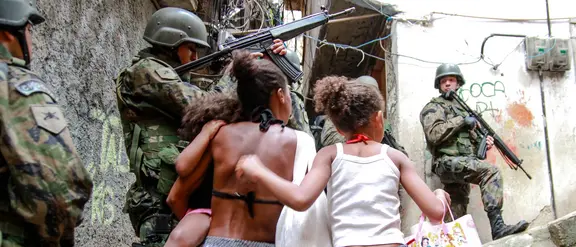
In the favelas of many Brazilian cities, conditions resemble war. For the children and young people who live there, deadly violence is a daily occurrence. Everyone knows of murders in their immediate surroundings. According to official figures, 44,000 people were killed in Brazil in 2024. The murder rate of minors is one of the highest in the world, and a significant proportion of these crimes are committed by the police, including military police. Weapons often used in these killings come from Germany and other parts of Europe. Most victims of police violence are Black, male, young, and poor. The prosecution of police officers and military personnel is inadequate; the police kill and often go unpunished.
More on this topic: TDH study “Stop killing us! Police violence against children and young people in Brazil and arms trafficking”
Aide Memoire “Brazil” (2-page article on the human rights situation in Brazil, Nov. 25)
At the end of October 2025, a police operation in two favelas in Rio de Janeiro resulted in the largest massacre in Brazilian history, with over 120 fatalities, including four police officers. Eyewitnesses reported that many victims were executed with head or neck shots at close range.
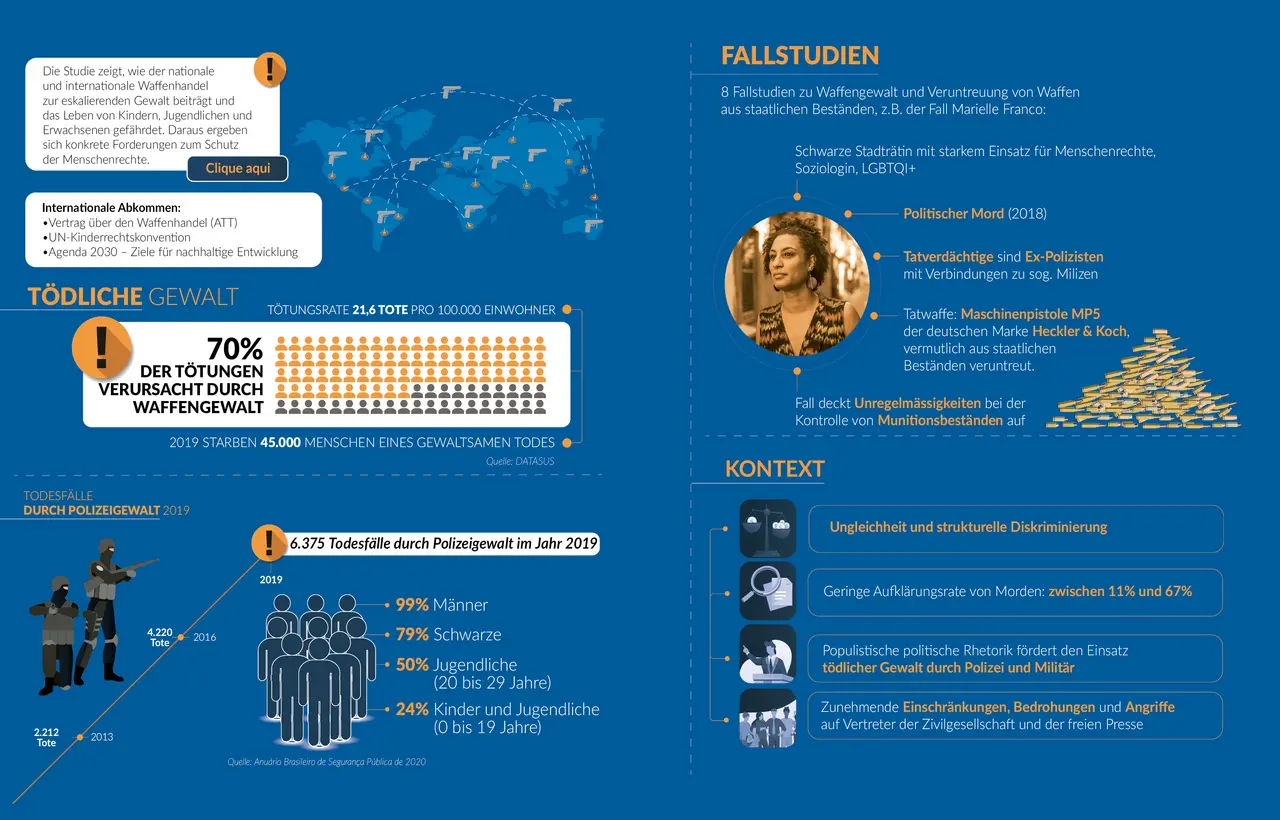
According to the Brazilian Yearbook of Public Security, 6,243 people died in Brazil in 2024 as a result of police violence. 82% of the victims were Afro-Brazilians, 99.2% male, over 50% under 24 years old, and about 10% under 18. In 2024, police officers were responsible for one in five violent killings of children and young people up to the age of 19.
According to available statistics, this makes the Brazilian police (including military police) by far the most violent in the world, killing an average of 17 people every day.
Although homicides overall in Brazil have decreased sharply since a peak in 2017, by 33% to around 44,000 cases (2024), deaths due to police violence have remained at this high level after a drastic triple increase from 2013 to 2019, reaching almost 6,400 in 2019. As a result, they now account for 14% of all violent deaths nationwide in Brazil – 19% in Rio, 22% in São Paulo, 26% in Bahia, and 24% and even 38% in the northern states located in the Amazon region, Pará and Amapá.
This means that the police, who are supposed to protect against murder and manslaughter, are themselves the perpetrators in one-fifth to one-third of fatal violent cases. In poorer neighborhoods, the rates are often significantly higher. The vast majority of the victims are Afro-Brazilians.
A major contributor to the wave of state violence was the right-wing president Jair Bolsonaro (2018-2022), who is now imprisoned for an attempted military coup. With his inflammatory speeches, he legitimized the brutal actions and incited the police to "shoot down all bandits." Some governors of Brazilian states, such as Tarcísio de Freitas of São Paulo and Claudio Castro of Rio de Janeiro, acted similarly.
The latter praised the success of the police operation in October 2025, which resulted in over 120 deaths, but claimed that four of the victims were the four police officers killed – all other fatalities were, in his view, not worth mentioning. This underscores his attitude and complicity in the escalation of violence. Since taking office in 2021, as governor, he has been responsible for the four deadliest police operations in recent Brazilian history, resulting in a combined death toll of nearly 200.
Thousands of demonstrators are rightly demanding legal consequences. The escalation of violence has also been criticized by the Brazilian judiciary and the federal government, which was not informed by the Rio state government prior to the police operation in October 2025, and investigations have been launched.
In Rio de Janeiro and throughout Brazil, thousands of people, including colleagues and partners of Terre des Hommes, as well as children and young people, demonstrated against the violence and brutality of police operations in impoverished neighborhoods following the massacre. They demand prosecution and serious debates on public safety, addressing how drug trafficking, the criminalization of drug users, the mass incarceration of Black people, and the widespread absence of effective government programs in education, health, and housing contribute to crime. They reject the blanket criminalization of Black, impoverished communities that is currently common practice. Our demands to the German Federal Government can be found here.
Lack of prosecution: Police kill and often go unpunished
Armed with highly powerful weapons, including those from Germany, Switzerland, and other European countries, police officers, acting on state orders, are waging a "war on drugs and criminals," often taking the law into their own hands and being directly involved in criminal activities. During their operations in the favelas, they frequently endanger or directly attack innocent bystanders, often including children and teenagers.
For example, in the case of 14-year-old João Pedro Martins from São Gonçalo in the greater Rio de Janeiro area: He was playing with his cousins when police officers shot at his family's house 72 times and threw two grenades.
Or take the case of 16-year-old Juan from São Paulo, where, in Jardim Elba in the Sapopemba neighborhood, where Terre des Hommes supports projects for children and young people (su), a plainclothes police officer broke into the home of the 16-year-old's family and shot him dead in front of his mother and five younger siblings. The killer remained in the house for an hour after the crime and, according to the shocked mother, was not held accountable by arriving military police, but rather congratulated. This incident occurred in 2020, and despite clear witness statements and circumstantial evidence, the perpetrator has still not been brought to trial.
This case, along with six others in São Paulo, Rio de Janeiro, Salvador, and Fortaleza, is detailed in our study, “Stop Killing Us! Police Violence Against Children and Young People in Brazil and the Arms Trade.” The study also investigated where German or European weapons were used and the role of both illegal and legal arms trafficking. The case studies document the use of Airbus helicopters and firearms from Heckler & Koch, SIG Sauer, and Walther in the most serious human rights violations.
In 2022, 2023 and 2024, German arms exports to Brazil amounted to 102, 58 and 101 million euros, including parts for helicopters and armored vehicles, small arms and ammunition, which are also used in police operations in impoverished neighborhoods.
Our study “German arms exports – European and international obligations”, written by Prof. Dr. Thilo Marauhn and two other international law experts, proves that many German arms exports, including those to Brazil, are illegal and violate the Arms Trade Treaty, the EU Common Position on arms exports and other international treaties such as the UN Convention on the Rights of the Child.
Failed drug and crime control
One reason for the escalation of violence is the failed drug and crime control measures that rely on violence. "A good bandit is a dead bandit" is a widespread motto.
Anyone living in a poor neighborhood who is male is generally suspected of being involved in the illegal drug trade or other criminal activities. However, acts of violence by police officers are usually ignored, and impunity is widespread.
demands
Due to massive police violence, lack of or inadequate prosecution, war-like conditions in residential areas, and serious deficiencies in the control of state stockpiles of ammunition and weapons, children, adolescents, and adults are at great risk.
Therefore, Terre des Hommes Germany, Terre des Hommes Switzerland and our local partner organizations in Brazil demand the following from the responsible state authorities, governments and companies in Germany, Switzerland and the EU:
- Immediate halt to all arms exports to Brazil
- Consistently demanding prosecution, especially in cases of crime and corruption by police officers, military personnel, and other public officials.
- Consistent condemnation of the escalation of violence and demand for compliance with human rights and international law
- Stop the transfer of arms technology and expertise to Brazil
- Stop the sale of weapons and military equipment by European companies in Brazil
- comprehensive and systematic controls on the final destination of already delivered armaments
- Demanding a Brazilian state strategy (at federal and state levels) to combat organized crime and ensure public safety that does not rely on violence in poor urban neighborhoods.
Instead of brutal police violence, which, as studies show, leads to an escalation of violence and at best the displacement of criminal structures to neighboring neighborhoods, Brazil should focus on local police units permanently stationed in the neighborhoods, which are in close dialogue with the local population (there are positive experiences with this in some federal states), violence prevention, peace education and support programs for education and career prospects for young people, and at the same time systematically cut off the money supply to organized crime: money laundering and corruption must be urgently prevented, the drug trade legalized under state supervision, the illegal arms trade, in which public officials are often involved, consistently prevented and state weapons arsenals significantly better guarded and controlled.
That this is possible with sufficient political will is demonstrated by the successful operation by Brazilian federal authorities (“Operation Carbono Oculto”) against organized crime in São Paulo’s business district in August 2025, in which evidence of tax evasion amounting to €1.2 billion and assets worth €500 million belonging to the so-called “First Command of the Capital” (Primeiro Comando do Capital - PCC) were seized, and not a single shot was fired. Furthermore, access to weapons for private individuals, which was significantly eased under the Bolsonaro administration (2018-2022), must be restricted again.
The escalation of violence in Brazil and the associated serious violations of children's rights must be stopped urgently – Germany, as one of Brazil's most important partners in trade and development cooperation and one of its largest arms suppliers, also bears responsibility here.