

Colombia: Protection for refugees from Venezuela
Even before the US attack, Venezuela was in deep crisis. The economy is barely functioning, poverty is widespread, and violence is commonplace. Nearly three million people are seeking refuge in neighboring Colombia. A Terre des Hommes project is helping refugee women and their children settle in.
Pebel saw no future for herself and her three children in Venezuela: “We didn’t have enough to eat,” she says. “There was hardly any work, and what little there was was very poorly paid. We had no money. And I often couldn’t send my children to school.” Mismanagement, corruption, and authoritarianism have led to a sharp increase in poverty, hunger, and violence in Venezuela. Nearly eight million people have already left the country. Almost three million of them—like Pebel—are hoping for help in Colombia.
But starting over is difficult: Many migrants lack legal residency status, and women in particular rarely find paid work. They live, for example, by selling fruit or sweets on the street. Their living conditions are often precarious, and the risk of exploitation is high. Fear, loneliness, and a feeling of hopelessness are daily companions for many.
Education for a self-determined future
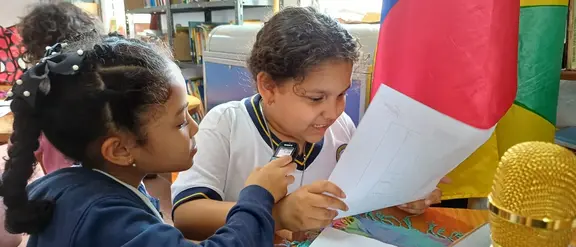
In the city of Medellín, the educational organization "Corporación Educativa Combos" cares for these women and their children. It receives support from Terre des Hommes and the German Federal Ministry for Economic Cooperation and Development (BMZ). Three hundred girls receive training in STEM subjects (science, technology, engineering, and mathematics), 300 in communications jobs (such as editing and radio production), and 150 women in business and crafts. A total of 600 women and 360 girls also have access to legal counseling and therapy sessions. Combos staff help with access to healthcare and job placement, for example. They listen and address urgent problems. And they ensure that girls and women receive education and training so they can later earn their own income and become independent.
Pebel also wants to train with Combos to become a so-called "people's therapist": She wants to help other women who have fled Venezuela to find their way in Colombia. She knows from her own experience what it means to leave home and start over in a foreign environment.