

interview
Zambia: From youth exchange to sustainable recycling company
Project cooperation with Dachser SE
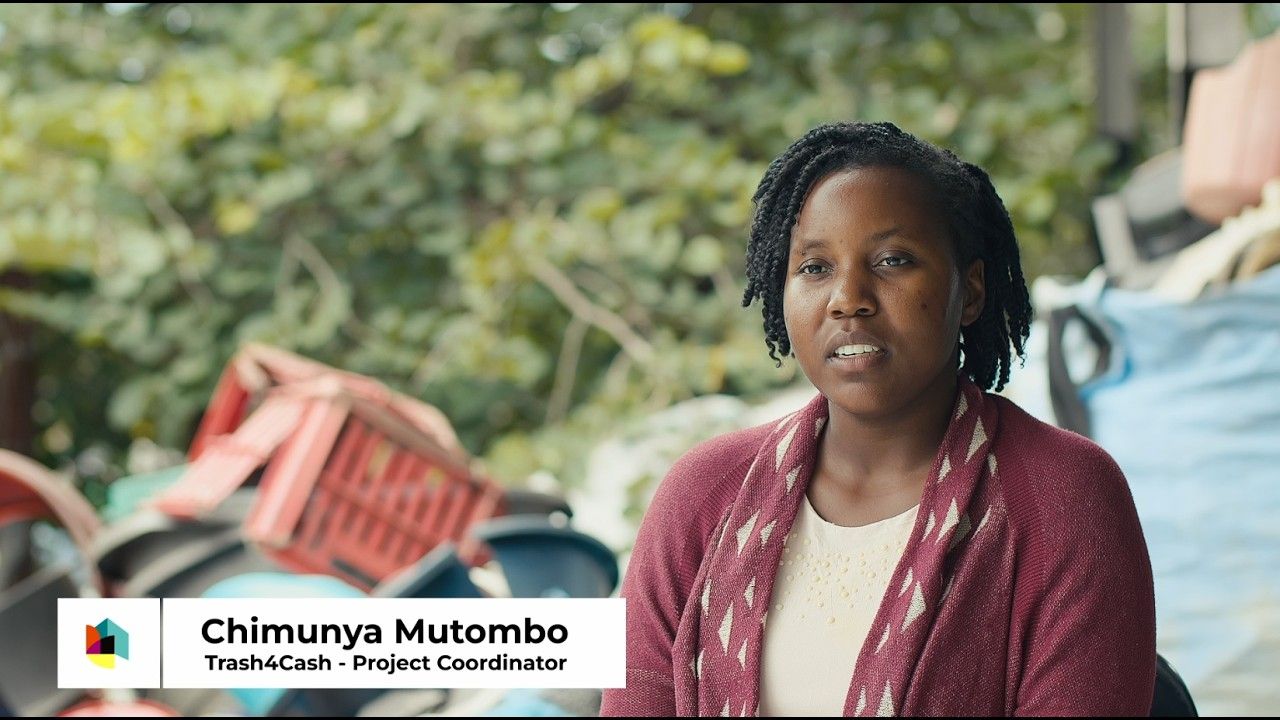
Terre des Hommes and the logistics company Dachser organized an international youth exchange focused on UN Sustainable Development Goal 11, "Sustainable Cities and Communities." During the exchange, the youth groups developed the idea for the now successful recycling company Trash4Cash in Livingstone, Zambia. The German-African Youth Office spoke with Joshua Hofert, Head of Communications at Terre des Hommes , and Bernhard Simon, Chairman of the Board of Directors at Dachser, about the exchange, and also conducted a video interview with Chimunya Mutombo, who works as a project coordinator at Trash4Cash.

Which moments do you particularly remember from the youth exchange “Completely utopian – until we do it! Young people in Zambia & Germany design livable cities”?
Joshua Hofert: The youth exchanges were a very special experience for the participants, one that completely changed many people's perspectives on themselves and the world. Working together on sustainability projects quickly challenged stereotypical ideas about each other's countries. Initial uncertainties soon gave way to interest and openness to new perspectives.
One concrete result was the "Trash4Cash" project in Livingstone. How did the idea for it come about?
Joshua Hofert: The idea originated during a visit to a small recycling center in Osnabrück. There, the young people experienced firsthand how recyclable materials can be collected, sorted, and processed locally in line with the principles of a circular economy. This visit was the initial spark for "Trash4Cash": The young people were immediately convinced that such a recycling hub could also be implemented in Livingstone.
Bernhard Simon: Initially, they had to overcome considerable resistance. The mayor of Livingstone at the time insisted on burning all waste, whether sorted or unsorted, at the central landfill outside the city. A year later, a new mayor took office, and at the same time, the city was selected for a UNIDO project to promote the circular economy. This allowed the young people to finally implement their idea. Their entrepreneurial spirit and their determination to create sustainable solutions to the local waste problem impressed us all greatly.

How did the idea become a functioning company?
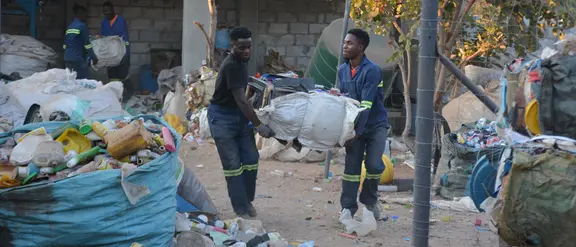
Bernhard Simon: It all started with a feasibility study to determine the quantities and types of waste generated in Livingstone. Based on this, the business concept was developed: The residents of Livingstone collect recyclables, primarily plastic waste, and Trash4Cash buys it by the kilogram. At the recycling hub, the waste is sorted and compacted. In the company's first phase, the plastic was transported to the capital, Lusaka, where it could be sold to companies that processed it into granules and reused it. Trash4Cash generated its revenue from these sales.
Joshua Hofert: Close cooperation with Livingstone City Council and the Zambian environmental authority was crucial for Trash4Cash. We supported Trash4Cash in becoming an official partner of the City of Livingstone in the UNIDO circular economy project in 2025. Since January, Trash4Cash has operated the first large recycling hub with recycling machinery. This allows for more efficient on-site processing of recyclable materials, which benefits both ecologically and economically.
How has the project changed the town of Livingstone?
Joshua Hofert: Thanks to the numerous Eco-Clubs established at schools in Livingstone as part of the project, the environmental awareness of children and young people regarding waste management has improved considerably. The waste collectors who sell plastic waste to Trash4Cash in the neighborhoods now earn a small additional income for their families.
Bernhard Simon: People are realizing that their waste isn't worthless; in fact, if they handle it correctly, they can even exchange "trash" for "cash." And very importantly: the young adults from Trash4Cash are no longer unemployed and are generating their own income as self-employed entrepreneurs.
How did the long-standing partnership between your institutions come about?
Joshua Hofert: The partnership dates back to the tsunami of Christmas 2004. A gigantic underwater earthquake claimed the lives of around 230,000 people along the coasts of the Indian Ocean. Terre des Hommes immediately received a large number of donations, which enabled them to help millions of homeless children and families. However, donations soon became scarce for other regions that were not in the public eye.
Bernhard Simon: We approached Terre des Hommes at the time with the intention of providing meaningful and sustainable aid. The recommendation was to focus our efforts not solely on immediate tsunami relief. Instead, the funds were initially deployed in the Indian state of Uttar Pradesh. Since then, the shared philosophy of Terre des Hommes and Dachser has been to design aid not as a sprint, but as a marathon.
What motivates and drives your continued involvement in this partnership to this day?
Bernhard Simon: We share the same values and goals and focus on grassroots projects supported by local civil society. In particular, we want to ensure that young people have opportunities in life and support them in seizing these opportunities. These are the principles by which we run our company.
Joshua Hofert: By selecting suitable local partner organizations, we stay close to the actual needs on the ground and operate with a long-term strategic vision for society. Numerous stories of young people who, with our support, have been able to start a new life, finally attend school, receive vocational training, or learn to cultivate their fields without pesticides and live healthy lives as a result, demonstrate the success of this approach.
What recommendations would you like to give to other companies or organizations here in Germany based on your experiences?
Bernhard Simon: Collaborations between NGOs and companies must be authentic. Corporate social responsibility should not be limited to PR purposes, but must be an integral part of the company's values and culture. The Trash4Cash project is a particularly good example of how Dachser combines its entrepreneurial expertise with Terre des Hommes ' strong civil society expertise to create a social entrepreneurship project. And in doing so, it brings young people together so they can shape their own future.
Interview: German-African Youth Office.
First published at: www.deutsch-afrikanisches-jugendwerk.de