

Interview:
"I had dreamed of sleeping in a soft bed."
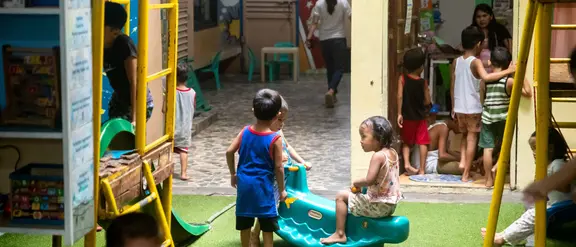
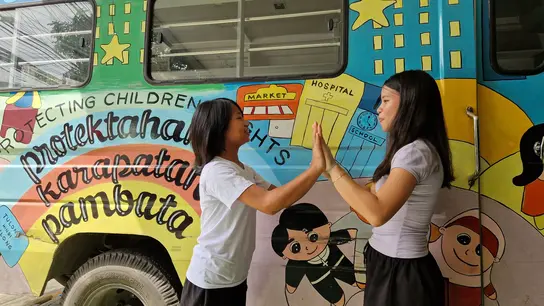
"Bahay Tuluyan" means "House of Refuge" in Tagalog, the Filipino language. It's the name of a children's rights organization that provides social services for children on the streets of Manila. With their own mobile outreach van, social workers travel directly to the children who need help most. They offer play and learning activities, listen to the children, and work with parents and guardians to find solutions: What does the child need to grow up healthy, go to school, and escape poverty?
Bahay Tuluyan, with the support of Terre des Hommes has reached, advised, and supported approximately 1,000 children and young people by 2025. The priority is always to help the children within their families and social environments. In exceptional, rare cases—for example, when the parents are no longer present or there is violence in the family—children are offered a place in the organization's residential program.
Currently, 60 children and young people between the ages of 3 and 18 live with Bahay Tuluyan. Two of them, Chabeng and Agatha, gave a joint interview Terre des Hommes in October 2025.
Chabeng, Agatha, thank you so much for taking the time for us! Would you like to briefly introduce yourselves? How old are you, and how long have you lived here?
Agatha: "I am Agatha, 18 years old. I have lived here since I was 5 years old."
Chabeng: "My name is Chabeng and I am 13 years old. I have been living here for about a year."
How did you meet the people of Bahay Tuluyan?
Agatha: “My older sister took care of us back then. She begged on the streets. One day, Catherine [Catherine Scerri, now director of Bahay Tuluyan] ran into her and explained that she could get help here. My sister said you could sleep in a real bed here. I had always dreamed of sleeping in a soft bed! And I got a place very quickly. My three little brothers live here now, too.”
Would you like to explain why your sister cared for you alone back then? And why you moved here?
Agatha: "That's okay. I'm here because our parents abandoned us."
Chabeng: “My story is similar. There are five of us siblings. One day, our mother left us without a word. Our father tried to take care of us, but we were in a bad way. We had no home and simply lived on the riverbank. Three of my siblings were taken into care by the DSW [Department of Social Welfare and Development]. The fourth still lives with my father. My mother now has a new husband and new children. They live on one of the other islands.”
Children who are abandoned
The abandonment of children by their parents in extreme poverty is a real problem not only in the Philippines. The reasons range from hopelessness and shame at not being able to feed their children, to the unsuccessful search for income elsewhere, and even legal disputes or the imprisonment of the parents.
How are you doing here? Do you like it?
Agatha: “Yes! We can live here, get food and help to go to school. For example, we don't have to pay for our school uniforms. But we also learn to be independent later on. It works like this: For children under 10, Bahay Tuluyan takes care of pretty much everything, even though the children already help out. Children from 11 to 14 become a bit more independent, learning, for example, to do their own laundry. From 15 onwards, there are initial training opportunities, for example here at the Makabata Guesthouse. The older children also help the younger ones with their homework.”
Chabeng: "And the food is so good! [Laughs.] I often didn't have much to eat before I came here. But now! For breakfast, there are sometimes eggs with bacon. Milk or hot chocolate. And fruit, for example, apples. For lunch, usually something with chicken, fish, or pork. For dessert, fruit, apples, watermelons, mangoes. And for dinner, vegetables."
Agatha: "Food is also an important part of our education. We have a game where the children prepare their own food for school. This helps us to learn and be independent."
[From the hallway, a small boy calls very loudly for Chabeng. The girls laugh.]
Chabeng: "This is Nathan. He's only four. And we're a little worried about his health because he can't breathe very well and can't run very much. Even though we're not really related, we all feel kind of like siblings."
Are you learning anything else here?
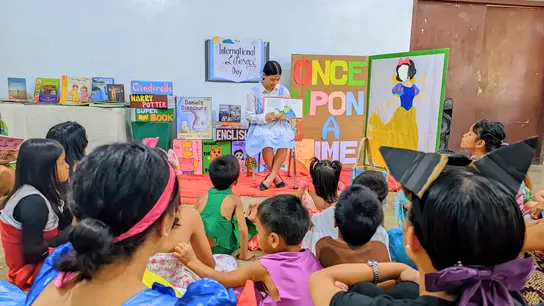
Agatha: "I think one of the most important things is that we learn that we have rights. Even as children. The right to education, for example. Right now, I'm learning a lot about my political rights. And it makes me proud that I can already teach others something."
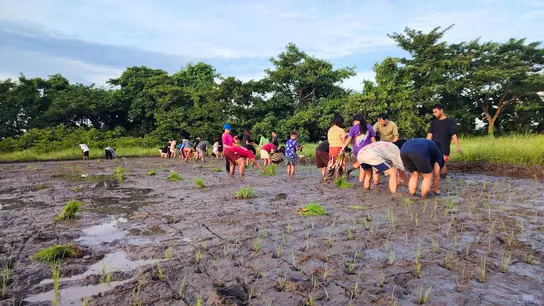
[Reflects:] "I've also learned a lot about plants and gardening. Last year there was a big typhoon, and many trees fell over. But we collected the scattered fruit and made fertilizer from it. So nothing was wasted and now new plants can grow."
And what about the fun? What can you do here in your free time?
Chabeng: "Mmmh, I thought it was great when we decorated the house in Laguna the other day. With decorations we made ourselves from recycled plastic! And I love just playing with the other children. Our favorite game is called 'Chinese Garter,' where you have to jump higher and higher over a rope."
Agatha: “Some of the children can jump so incredibly high, it looks like they’re flying. [Laughs] What I really like are our visits to the International School in Manila. There’s a partnership with Bahay Tuluyan. The students come here and paint with us. And once a year we can go there for a learning visit. We can go swimming in the pool, paint in the art room, and play drums in the music room. We can dance ballet, climb, and act in plays. The school is very modern; to me, it sometimes feels more like a shopping mall.”
Agatha, you said you're 18 years old. Will you be leaving home soon? Do you have any plans for the future?
Agatha: "Yes, I'm applying for a scholarship. I'm also getting help here with that, for example, with job interviews and writing my CV. I want to become an accountant; I love math. Even though it will be hard for me to leave here."
Interview: Stephan Pohlmann
Published 23.03.2026