

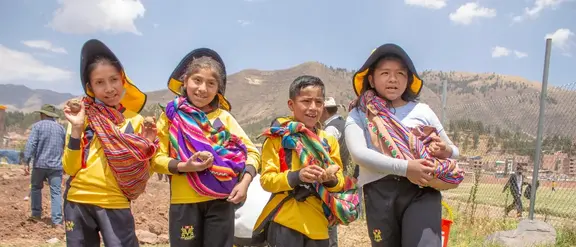
A good life – who wouldn't want that?
The economic and social model of industrialized nations has created prosperity in many countries and enabled many people to live a "good life." But this economic system is now largely responsible for global environmental crises, poverty, and inequality. Children suffer the most.
Therefore, the children's rights organization Terre des Hommes also faces the question of what a sustainable development can look like that enables a good life for all and helps to uphold children's and human rights.
"What is the good life for you? Does that work as 'a good life for everyone'?"

A good life – what does that actually mean?
The concept of the "good life" represents an understanding of prosperity that prioritizes other values over competition and the accumulation of material goods: good social interaction, justice, leisure and free time ("time affluence"), a life in harmony with nature, etc. The post-growth or degrowth movement advocates a transformation path towards forms of economic activity and social (self-)organization in which the well-being of all is central and the ecological foundations of life are preserved.
The good life – and its limits
In (Western?) industrialized societies, notions of prosperity and a good life are shaped by the pursuit of virtually unlimited consumption. The driving force behind such consumerist affluence is perpetual economic growth, which is accompanied by high resource consumption and the exploitation of people and nature.
However, unlimited growth is not possible on a finite planet. An economic system geared towards permanent growth comes at a high price: it leads to environmental destruction, vast social inequality, and erodes social cohesion. These negative effects disproportionately affect people in the Global South.
Criticism of this growth model is not new, but it is increasing. As an alternative, forms of economic activity are being tested that prioritize the well-being of all and preserve the ecological foundations of life (community-supported agriculture, socially responsible businesses, universal basic income).
"What does your positive future look like? What is needed to make it a reality?"
How can a good life be possible for everyone?
In societies geared towards economic growth, more and more people are already orienting themselves towards the principles of "post-growth" by, for example, foregoing material improvement in favor of more time, adopting a vegan diet, or joining solidarity-based initiatives oriented towards the common good.
These are important approaches, but people cannot change the imperial economic system simply by altering their individual lifestyles. For a good life to be possible for everyone worldwide, new social frameworks are needed, based on the principles of global justice, social inclusion, and ecological sustainability.
Change must originate in the industrialized nations of the Global North. It can succeed if we clearly define what we are striving for: a world in which we can grow and develop in peace; in which humanity and nature retain their dignity; in which we have time for what is important to us; in which everyone can contribute their abilities…
background
The working group "Alternative Development" has examined various alternative development concepts. These are:
- the post-growth debate in the global North
- the Buen Vivir concept from the Andean region
- the African discussion under the keyword Ubuntu,
- the discussion in India under the heading Radical Ecological Democracy (RED)