

When schools in Ratchaburi, Thailand, reopened after the long COVID-19 lockdowns, the joy of many children was surprisingly muted. "The children didn't want to go back. They didn't see school as a place of joy or happiness," recalls school principal Pleaw Purisan. Instead of enthusiasm, there was frustration, aggression, and insecurity. Teachers faced truancy, arguments, and concentration problems.
A similar picture emerged at a children's center in Bangkok: younger children reacted with crying or aggression, while older children reported bullying and a lack of self-confidence. To address these developments, the project "Plearn to Play: Improving Well-Being and Promoting a Safe Environment for All Children to Play" was launched.
Supported by the "a chance to play" program and implemented by the Center for the Protection of Children's Rights (CPCR) Foundation, it pursues a clear goal: to make school a place where learning and the joy of life go hand in hand. The word "plearn" in the project title means "to enjoy" in Thai and also alludes to the concept of "learn to play.".
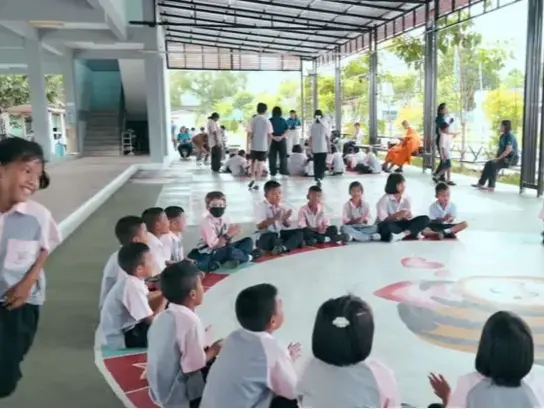
Learning through play
The approach is as simple as it is effective: classrooms are transformed into spaces of creativity. Children learn by incorporating their interests into playful activities. "I make my younger classmates laugh and help them enjoy their tasks. That motivates me and puts me in a positive mood," says the 14-year-old. He now dreams of working as a YouTuber or in online sales – professions he previously wouldn't have considered.
Chaiyaphruek (14) has also changed through the project: “I’ve become more self-confident, braver, and stronger. Now I believe I can use these skills in school and in my career. Maybe I’ll even become an actor.” Formerly shy, he now playfully takes on the role of children’s entertainer – a development that his mother has also noticed: “He now speaks much more openly with us parents and freely expresses his opinion.”
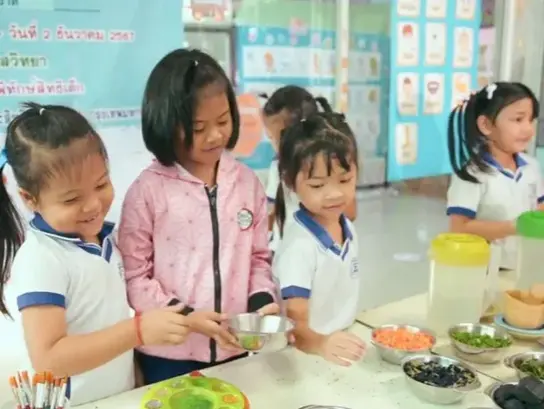
A new way of being together
Besides the children, the teachers also benefit. Regular "play days" allow them to observe children more closely and identify difficulties early on.
Rattiya Kitsadanon, a teacher known for her strictness, describes her transformation this way: “Before, students didn’t come to me when they needed advice. Through this project, I learned to change my perspective. Today, I use play in art and science classes, support older students in guiding younger ones, and am available as a trusted teacher. Most importantly, however, I can now be a safe space for the children.”
The changes brought about by the project are measurable. Attendance has improved, with many children now even arriving before school starts. Parents report that their children wake up more excited in the mornings. At home, they are more active and communicate more openly.
For Malai Chaiburin, head of the children's center, which also uses the methodology, the change is undeniable: "What was once a place of stress has become a community full of joy and a sense of belonging."
The project impressively demonstrates how closely play, learning, and mental well-being are linked. Looking back on the "Plearn to Play" project, it's clear that the influence of play and creativity not only improved learning but also released a great deal of positive energy. Other schools have incorporated the project's suggestions into their curricula, and CPCR's work has thus become a model for other educational institutions in Thailand.
This project is part of the "A Chance to Play", through which Volkswagen employees, together with the Volkswagen Group Works Council, have been supporting projects for children and young people worldwide for 25 years. In cooperation with Terre des Hommes sustainable opportunities for young people are being promoted.
More about the program