

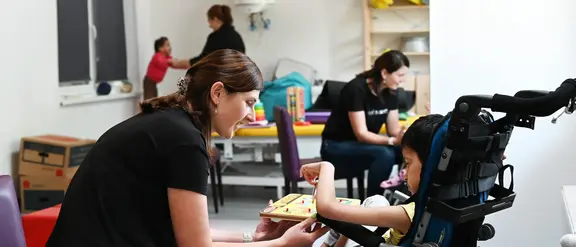
Ukraine: A rehabilitation center for children with severe disabilities
“Now, during the war, many children with disabilities are primarily concerned with safety and basic necessities,” says project coordinator Lesya Levko. “That makes it all the more important for them to see that even in these difficult times, positive changes are possible.”
There is a less frequently considered group of children in Ukraine who are suffering particularly, and increasingly so, from the Russian attacks: those who already needed medical and therapeutic assistance.
Before Russia expanded its war of aggression beyond Crimea in 2022, an estimated 164,000 children with physical or mental disabilities lived in Ukraine. New estimates indicate that this number has more than doubled due to war injuries.
Meanwhile, health and social services have been destroyed in many places. Millions of people are internally displaced. Although parents are doing everything they can to give their daughters and sons a dignified childhood, life in war robs them of all stability and leaves them with hardly any safe places.
Creating such safe, child-friendly spaces is a key focus of the project that Terre des Hommes therapy rooms are being established. Eighty professionals are being trained, for example in the fields of physiotherapy and psychology. More than 4,000 vulnerable people will finally be able to receive the help they need and deserve.
sufficient
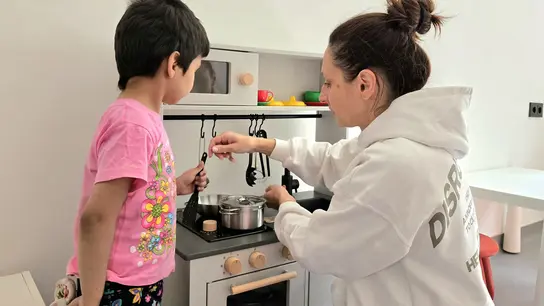
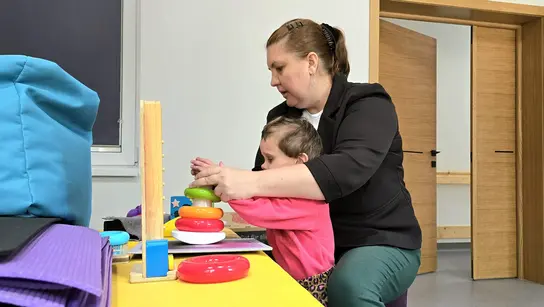
A key element of the project: In the town of Vilshany, the partner organization CAMZ renovated a care center – for children with particularly severe disabilities who therefore needed continuous, inpatient care.
Vilshany is located in a remote area in the mountainous region of Transcarpathia in western Ukraine. Precisely because the location is relatively safe, the orphanage has had to provide refuge for far more children since the beginning of the war than ever planned.
“The war has changed a lot,” explains Lesya Levko, who coordinates the CAMZ projects in Ukraine. “Especially from the east of the country, many more children had to be taken in by the center. In dormitories that were already completely full, the caregivers had to make room for extra beds. Some children were only able to stay in converted play and exercise rooms. And the staff were working at their limit the whole time.”
The project is an example of how humanitarian emergency aid and long-term development aid can be effectively integrated in development cooperation.
CAMZ operates as part of a Terre des Hommes aid network. Originally launched as an emergency relief project under the auspices of the German Federal Foreign Office, the long-term aid is now being continued under the purview of the Federal Ministry for Economic Cooperation and Development. The center in Vilschany is integrated into a long-term program that provides comprehensive rehabilitation, trains additional specialists, and offers support services for children in the surrounding communities.
CAMZ made it their mission to enlarge and improve the center. Project staff renovated and extended the main building, creating new, brighter, and more modern annexes. A total of 184 children and young people now have ample space. A solar thermal system with a heat pump ensures warmth, so no one has to freeze even when Ukraine's district heating network is under strain in winter.
Brighter, freer, more open – a new outlook on life.
CAMZ also established a completely new area: a living and learning space that paves the way for greater independence for young people as they gradually mature. This includes their own apartments and the inclusive "Café Kosytsia," which they can run themselves.
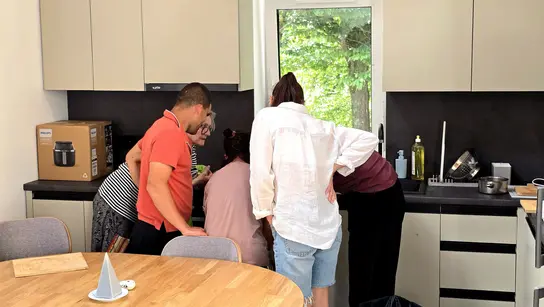
One of the young adults already living here is Edita. She grew up in Vilshany and is now 29 years old. Here she has made friends, discovered and developed her creative abilities. She regularly attends workshops, is a member of the facility's artistic ensemble, and now also works in the café. Moving into the small, accessible house on the facility's grounds fundamentally changed Edita's daily life—even though her new home is only a few hundred meters from the main buildings.
"I'm going to work and the workshops now – and then I'm going home."
In her new daily routine, Edita takes on responsibilities in the kitchen and helps the children in a neighboring house. She decides for herself how her room looks. She chooses where her pictures hang, invites staff members for coffee, and enjoys her own private space. Closeness and security remain – but on a new, more self-determined level.
The path to greater autonomy and independence
The new housing option also yielded important insights for the professionals. Residents learned many everyday skills, such as cooking, household management, and using appliances, significantly faster than expected. The next focus is now on more complex topics: financial literacy, self-advocacy, and external communication – skills that are crucial for a more independent life.
Edita is already actively using the new opportunities: She sends friends photos of home-cooked meals, her creative work, or the festive decorations in her house. Small gestures – with great significance. Edita's story is representative of the path now open to children and young people in Vilshany: Despite severe and complex disabilities, they are given a real chance here for a more independent, dignified, and fulfilling life.
Former "homes" for children with disabilities are not only a relic of bygone days – such as the Soviet era – in Ukraine. The fact that children were taken to remote locations and isolated was and is in no way compatible with children's rights.
Like many other countries, Ukraine has initiated a process of reappraisal and reform in recent years, which is referred to in technical terms as "deinstitutionalization": it is the opposite of isolation and seclusion. The aim of the reform is to open up institutions and give people with disabilities real opportunities for a self-determined life.
The renovated rehabilitation center in Vilshany is already considered a successful example of this change.
16.02.2026