

Vietnam:
Children's hospitals in war – schooling in peace
In 1967, committed individuals founded Terre des Hommes Germany. Their goal: to rescue severely injured children from the horrors of the Vietnam War and ensure they receive medical care in Germany.
Years later, as the country embarks on the long road back to peace, Terre des Hommes active on the ground with local projects: from building hospitals and rehabilitation centers to fighting hunger and poverty, and advocating for the right to education – for six decades we have been providing aid to children in Vietnam.
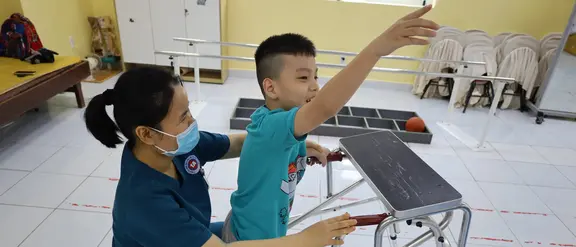
"Huy is getting better and better with the therapy here," his mother says happily. "He can now hold onto the handlebars, ride his therapy bike, sit up, and watch television."
Huy, now 11 years old, comes from South Vietnam. He suffers from cerebral palsy. When he was younger, he couldn't turn over, couldn't sit steadily, and could barely interact with other people. Finding suitable treatment seemed impossible: the hospital was too far away, and the family didn't have enough money.


In 2018, however, Huy received a free therapy placement at the Orthopedic and Rehabilitation Hospital in Ho Chi Minh City, Vietnam's largest therapy center for children with severe physical disabilities. Since then, Huy has lived there for most of the year, usually accompanied by his mother. He receives daily play and physical therapy, which he clearly enjoys.
From emergency aid during wartime to a modern children's therapy center:
The hospital originated from the work of Terre des Hommes during the Vietnam War. In 1971, the organization established a medical and social care center in the capital, providing care for children who had been orphaned by the war, suffered injuries, or were malnourished. In 1977, a rehabilitation center for children with polio was added.
From both institutions, two children's hospitals later emerged, which today stand on their own two feet: the Orthopedic and Rehabilitation Hospital for Children (CREP¹) and the Center for Malnourished Children (CROM²).


The orthopedic and rehabilitation hospital in Ho Chi Minh City is an early success story of Terre des Hommes. The center was initially fully funded by Terre des Hommes – from construction and operation to treatment, including living expenses and travel costs for the patients. Today, it can admit 350 children at a time. For decades, the hospital has helped thousands of children suffering from polio or war-related illnesses – especially the long-term effects of the nerve agent Agent Orange.
From the 2000s onward, the hospital was gradually transferred to state ownership. Since 2025, it has operated without Terre des Hommes funding. Moreover, the center became a model for the medical care of people with disabilities in Vietnam. It laid the foundation for a specialized healthcare system and created opportunities for the inclusion of thousands of children.
Thanks to the orthopedic and rehabilitation hospital, children like Huy received, and still receive, the therapy they urgently need. The results speak for themselves: Huy's well-being has also improved significantly. He recognizes the medical staff and interacts with them, enjoys meeting nurses, and is overjoyed when he sees family members.
"I really hope that one day Huy will be able to walk without his therapy bike," says his mother. "Then we'll go home together."
Terre des Hommes in Vietnam
From emergency aid in war to support in peacetime
When Vietnam began to focus more on economic development and poverty reduction in the 1990s, a new phase also began for Terre des Hommes ' project work in the country.
Terre des Hommes expanded its strategy from emergency relief to community development and "helping people to help themselves": Our organization – always in collaboration with local partner organizations – established nutrition programs and clean drinking water infrastructure to mitigate the immediate consequences of war and poverty. Terre des Hommes created education and scholarship programs to enable marginalized children to attend school.
Over time, more and more participatory projects emerged in which children themselves took the initiative. Since 2011, a key focus of the work has been on children's right to a healthy environment: children and young people in the country are actively campaigning for the protection of their livelihoods and their health.
¹Originally: Centre de Réhabilitation des Enfants Paraplégiques: Rehabilitation Center for Paraplegic Children
²Originally: Centre de Réhabilitation des Orphelins Malnutris: Rehabilitation Centre for Malnourished Orphans