

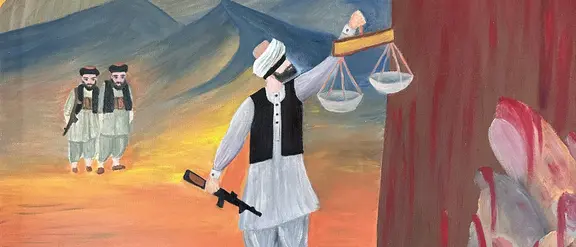
Wassim was born in Jalalabad, a city in eastern Afghanistan. He grew up in a Pashtun family and had a happy childhood: "I was always out with my friends, cousins, brothers – we had a really good time." But his father's work in the military brought risks. One day, on his way home from school – Wassim was ten years old – he was brutally beaten by several unknown men: "They said to me: 'Tell your father to quit his job immediately.'".
For the family, it was clear: "We had to leave, immediately, without telling anyone." They moved to Kabul. Five years later, the Taliban seized power. While they carried out reprisals nationwide, Wassim's father decided to flee as quickly as possible. "We had no passports; we had to leave illegally."
The escape led through Pakistan to Iran. Amidst the chaos at the border, he lost his family. "I never wanted to leave without my family. But the Iranian police started shooting, everyone panicked. We were separated, and I ran. My family was arrested." He made it across the border—alone. He was 15 years old at the time.
Thus began an escape that took him through numerous countries for over a year – always under inhumane conditions, dependent on smugglers, in fear of the police, and without contact with his family. In Greece, he was beaten by the police and pushed back to Turkey; in Bulgaria, he lived in forests for weeks; in Serbia, in an overcrowded camp; then he was locked on the back of a truck for four days: "I wasn't dead, but I wasn't really alive either. I was something in between." His escape finally ended in Germany.
To this day, he is haunted by the experiences he endured while fleeing. "I saw so many people who died. Young people like me. Sometimes I think my eyes should be cameras so that people here can see what I saw. Maybe then they would understand us."
Even though he now lives safely in Germany, the experiences and the situation in his homeland still haunt him. Wassim follows what is happening in Afghanistan: "I see on social media that young people in particular have lost all hope. They have no work, can't say what they think, can't do what they want. Their lives are like a prison, and they are forced to serve the prison guards."
This lack of prospects also affects his friends and relatives who are still in Afghanistan. "People there are tired of life. Perhaps there isn't an open war right now, but that doesn't mean it's safe. There are no rights, no economic security, no income, just hunger, poverty, and violence. I wouldn't know how to survive there."
Through his experiences as a refugee and his time in Germany, Wassim has developed a clear political stance: “I stand for human rights – that’s the most important thing to me. I’m for women’s rights, for freedom of the press, for civil society. I want a free life for everyone. The Taliban would never accept me as I am – how I think, how I want to live, even how I wear my hair. But I wouldn’t stay silent. And I could never cooperate, spy on my neighbors, betray my friends and everything I believe in – but that’s what they demand. Because of my opinion, the Taliban would arrest me, my life would be in danger. I might already have been killed.”
Even in Germany, the feeling of insecurity remains his constant companion. "I'm still anxious. At school, at work, on the street – I often think the police might come and force me to go back."
Wassim dreams of graduating from school, training to become a car mechanic – and of supporting other people: “I want to work, build something, help others. I have friends who, like me, have fled and are so desperate that they want to take their own lives. I want to help them give their lives meaning again.”