Brazil: Prospects through education and sustainable agriculture
Our project with the Landless Workers' Movement (MST) and the Cultivar Institute provides agricultural and environmental education in schools and communities. The goal is to combat poverty, improve food security, protect local ecosystems, and contribute to the implementation of a just agrarian reform.
In Brazil, a small elite has acquired vast tracts of land. From here, global markets are supplied with soy, corn, coffee, sugarcane, and beef. At the same time, millions of people own no arable land at all: the so-called "landless." These are primarily the families of former small farmers and agricultural laborers whose jobs were lost due to industrialization and mechanization.
Amidst land conflicts and environmental crises,
agrarian reform aims to distribute land more equitably, giving small farms and farmers a chance to produce more food for the domestic market. However, there is still a long way to go: in many places, poverty and land conflicts are commonplace. Traditional agriculture suffers further because large-scale industrial farms deplete soil and water resources and destroy biodiversity. Small-scale farmers also lack the resources and information to adapt to increasingly difficult environmental conditions. Outdated educational and training content fails to reflect their lived reality.
"Defending nature means defending our land."
What does agroecological education mean and why is it so important that children and young people are actively involved in the fight for justice? We spoke about this with João Vitor and Clara Duarte, two young participants in our project, as well as with Maria Leomar from MST.
About the interviewThis is where our project comes in – with ecological education, practical training, and the teaching of local, sustainable production methods, starting in schools. The goal is to empower young people to practice ecologically and economically sustainable agriculture and thus actively participate in the implementation of agricultural reform. Furthermore, Terre des Hommes supports social movements in communities to ensure that change from the ground up is sustainable.
Agroecology as a learning and living space
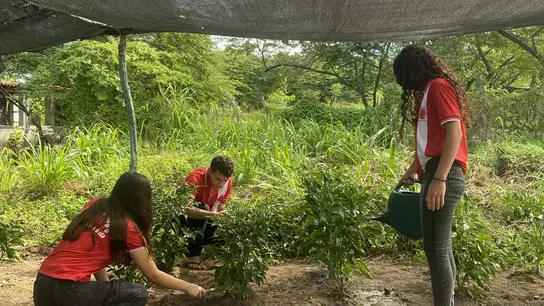
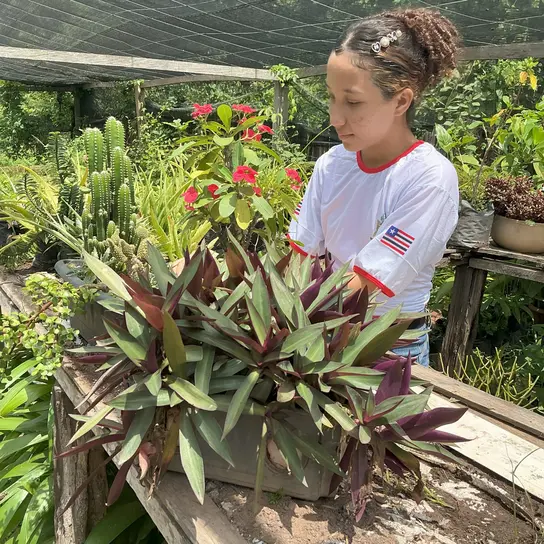
The project began at eleven schools and is now being expanded to six more. The core of the approach is the integration of agriculture and ecology into everyday school life: curricula, school gardens, and agricultural and forestry areas connect theory and practice.
Our partner – the "Movimento dos Trabalhadores Rurais Sem Terra" (MST) – plays a central role in implementing agrarian reform in Brazil: This rural workers' movement organizes peaceful land occupations, supports land redistribution, and promotes collective agriculture. Education and youth work are high priorities for the MST. The organization directly links educational work with agricultural practice and social mobilization.
The MST originated in the 1970s in southern Brazil as a reaction to the modernization of agriculture, which deprived many farm workers of their jobs through mechanization.
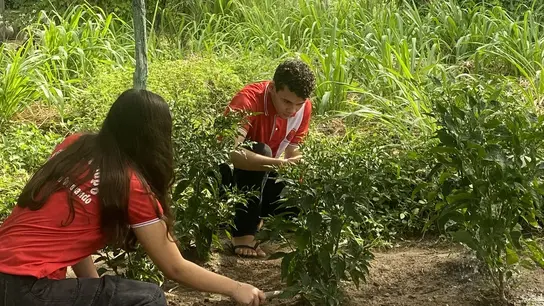
"We learn practical skills like how to care for the soil and grow plants. This helps me think about my future – maybe I'll do an apprenticeship in agriculture."
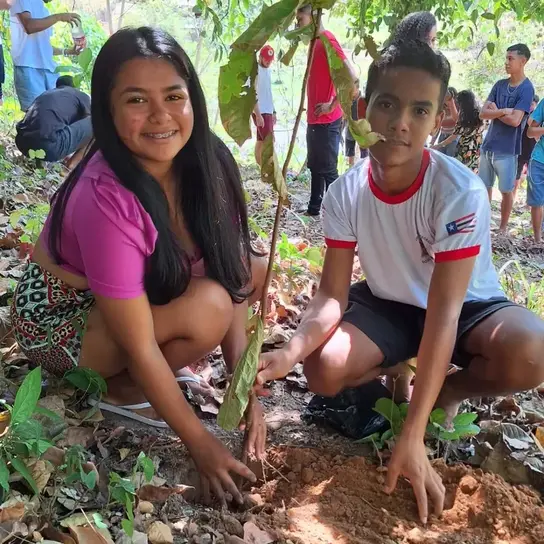
Lessons don't just cover sustainable farming methods — students work in the school garden, create small agricultural and forestry areas, and learn the basics of agricultural planning.
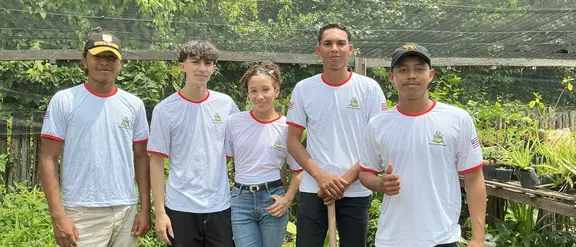
Young people actively participate in shaping the project and implementation of the agricultural reform: In youth groups (»Núcleos de Base«) children and young people meet regularly, carry out practical work, discuss projects, make decisions and thus strengthen their skills in teamwork, planning and political participation.
"I help in the school garden: We plant and water. And we look out for each other. I'm always happy when we share the harvest."
Numbers and impact
- The project will reach approximately 1,700 students and empower them to become multipliers for agroecological knowledge.
- Approximately 150 teachers and local education mentors will be trained.
- 900 children and young people are already active in local youth groups (»Núcleos de Base«) for the implementation of agrarian reform and children's rights.
Many advances in the agricultural reform areas are only made possible through the partnership and support of Dachser SE. Through its commitment, the company promotes local technical equipment, facilitates training, and strengthens the networking of schools and communities.