Climate adaptation strategies neglect children
New study by Terre des Hommes and the Independent Institute for Environmental Issues
Heat waves demonstrably harm children – even in Germany. They lead to increased exhaustion, concentration problems, and psychological stress. Nevertheless, children and young people remain largely invisible in Germany's climate adaptation efforts.
This is the central finding of an analysis by the Independent Institute for Environmental Issues, commissioned by Terre des Hommes , which evaluated climate adaptation concepts from the federal government, the states and the ten largest German cities.
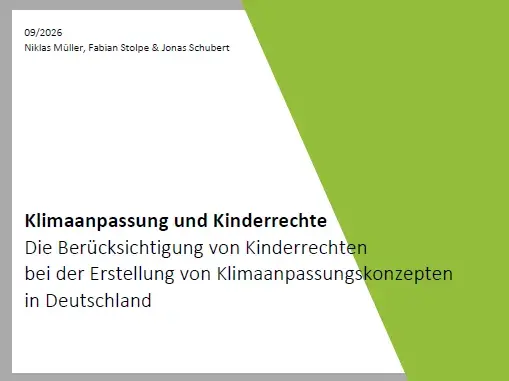
Children's rights are lacking as a benchmark, participation is the exception
The analysis shows that while German climate adaptation strategies recognize children and young people as a vulnerable group to heat and UV radiation, they neglect other climate-related health risks such as heavy rainfall, allergens, and mental health issues. Children's rights—such as the right to a healthy environment, reaffirmed by the UN Committee on the Rights of the Child in 2023—are not cited as a binding benchmark.
Direct link to the study (PDF)Demand: From protected objects to actors
Given that the German Climate Adaptation Act obliges the federal states to submit climate adaptation concepts by January 31, 2027, Terre des Hommes and the Independent Institute for Environmental Issues demand:
- Target group-oriented participation: Children and young people must be systematically and age-appropriately involved in the development and implementation of climate adaptation concepts.
- Everyday spaces as places for participation: Daycare centers, schools, playgrounds and neighborhoods should not only be used as critical infrastructures, but actively as places for participation and empowerment.
- Anchoring education: Curricula must include target-group-oriented materials on climate impacts and adaptation options - based on United Nations General Comment No. 26.
- Comprehensive protection: Children and young people must be protected from all health risks and social disadvantages caused by the consequences of climate change.
Your contact person
Jonas Schubert
Speaker Advocacy