

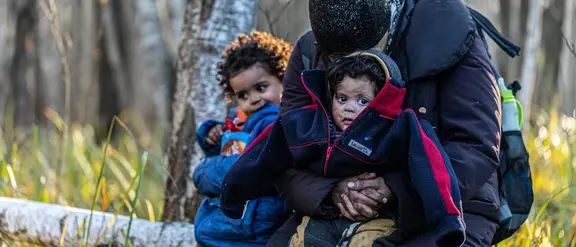
Poland: Aid for refugee children and their families
Since 2021, there has been a dramatic humanitarian crisis on the Polish-Belarusian border: Refugees, including many children and families, are being violently pushed back by Polish and Belarusian border guards and prevented from applying for asylum.
These illegal pushbacks violate international law. The arbitrary treatment and violence to which people are subjected leave deep physical and psychological scars, especially on children and young people. To escape this violence, the children and young people sometimes hide for months in the forests near the border. There they suffer from hunger, thirst, and extreme temperatures – heat in the summer and cold down to minus 20 degrees Celsius in the winter. Many are seriously injured trying to cross the five-meter-high border fence topped with barbed wire.
Nobody flees without a reason
People who endure such extreme hardships and put themselves in mortal danger to escape do so only for profound and very serious reasons. Most come from crisis-ridden countries like Afghanistan, Syria, or Somalia, where war, violence, and oppression prevail. Many children and young people also flee to escape forced recruitment or forced marriage. All unaccompanied minors have the right to asylum, but this right is disregarded and met with violence at the Polish-Belarusian border.
Prison sentences instead of protection
Many refugees who manage to cross the border from Belarus into Poland are initially detained there. This includes a large number of minors – because they are classified as adults without proper examination. They are housed in so-called "Guarded Centers for Foreigners": these camps resemble prisons. The conditions under which children and young people are held there, often alone or with their families, for months at a time, are inhumane: many young people report severe abuse and humiliation to which they were subjected.
Help knows no bounds
Amidst the grim and violent reality on the Polish-Belarusian border, our partner organizations SIP and Egala are a beacon of hope. Their staff receive calls for help via messaging services or through a central control room with an international emergency hotline that forwards calls from people fleeing persecution. Egala's specialists immediately rush to those seeking help, distributing sleeping bags, warm clothing, thermoses of hot soup, and power banks for mobile phones. They provide urgently needed first aid for injuries and illnesses. And they support refugees with their asylum applications. These courageous helpers work tirelessly to offer hope and support to children and young people in their greatest hour of need.
Interview with our expert Teresa Wilmes
What impressions did you bring back from your last visit in July?
The atmosphere was noticeably more tense. Since June, the Polish government has established a restricted zone along the border, where organizations are unable to provide assistance. Our partners sense that the hatred is increasing. Attacks on aid workers are on the rise; some have even been threatened with weapons by a right-wing vigilante group. This is precisely why Egala's tireless efforts—and their heartbreaking, yet also beautiful, stories—move me so deeply: stories of children who, after weeks in the forest, can no longer play at all, and stories of people with whom Egala remains in contact, who are now finally living in safety and peace. The unwavering conviction of Egala's staff that helping people is and always will be the right thing to do: this continues to give me courage despite everything.
What would a humane solution look like from Terre des Hommes point of view?
All children, all young people, all people have the right to have their asylum application heard and examined in Europe. This right is violated daily at many of the EU's external borders. In particular, children and families need safe routes to Europe so they even have the chance to seek protection without risking their lives. This requires comprehensive reception programs instead of the hatred and incitement we are currently witnessing.
For over forty years, Terre des Hommes has been supporting young refugees coming to Germany. What can we learn from this for the debate on refugees and migration?
Children and young people seeking refuge with us are fleeing wars and violence. Many of them want to find a new home and safety. Currently, we are witnessing anti-immigrant rhetoric worldwide, which is increasingly turning into violence against refugees. Even and especially in these times, it is our duty as a children's rights organization to repeatedly clarify: the inadequate funding of the education system, the lack of housing, and the shortage of childcare places are the result of misguided social policies over the past decades. Blaming refugees for all of this is wrong and fuels hatred. Together with children and young people, and also in large civil society alliances, we are therefore opposing the shift to the right and continuing to demand a child-friendly and humane asylum and migration policy.
Help with a donation