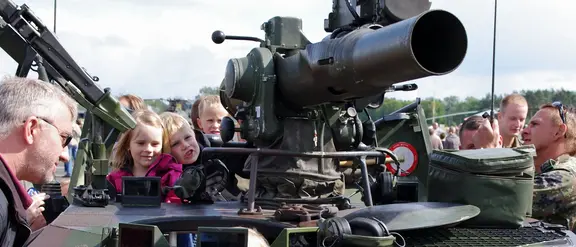
The German Armed Forces are recruiting and advertising children
The German Armed Forces (Bundeswehr) need around 20,000 new recruits every year. To reach this number, recruitment efforts are significantly expanded, and minors are recruited as soldiers annually: in 2024, 2,203 17-year-olds were recruited, including 321 girls, representing another 10 percent increase compared to the previous year and a new record high. These minors receive the same military training with weapons as adult soldiers and are often deployed abroad soon after reaching the age of majority. In the last ten years, the Bundeswehr has recruited more than 22,000 minors as soldiers.
Our demands
- Raising the recruitment age for the German Armed Forces to at least 18 years! (Straight-18 standard)
- Stop all forms of military advertising to children and young people!
- The publication of the age of soldiers who are affected by internal Bundeswehr legal violations such as sexual abuse, degrading initiation rituals or bullying, or who are injured, traumatized or die during training or deployment.
The UN Committee on the Rights of the Child in Geneva, the Children's Commission of the German Bundestag, and an SPD position paper call for this from the German government, as do other states such as Sweden in the UN Human Rights Council.
The international Straight-18 standard is adhered to by over 150 countries worldwide, including the vast majority of NATO and EU member states.
In February 2025, we handed over more than 32,000 signatures to the Federal Minister of Defense, Pistorius, and recently contacted him again with a letter, together with the campaign " Under 18 Never! No Minors in the Bundeswehr ," a coalition of ten organizations from the fields of trade unions, churches, human rights, and peace, representing a combined membership of more than 300,000. ( The handover is shown in the video.
) During our personal conversation, the Minister informed us that he fundamentally shares our criticism of the recruitment of underage soldiers. However, these words must be followed by action!
Because every year there are serious violations of children's rights among 17-year-old soldiers in the German Armed Forces – serious violations of the obligations of the UN Convention on the Rights of the Child (including protection from violence, protection from sexual violence, right to life, protection from risky child labor), which applies to everyone under 18, and Convention 182 of the International Labour Organization ILO (ending the worst forms of child labour).
National laws are also violated: legal protections for minors no longer apply. The girls and boys are housed together with adult soldiers, they have the same working hours, and there are no special protective measures against bullying or assault – even though, according to a Bundeswehr study, more than half of all female soldiers in the Bundeswehr have been sexually harassed and about one in thirty a victim of sexual abuse (source: Center for Military History and Social Sciences of the Bundeswehr, 2014).
In 2023 alone, according to the Ministry of Defense, 15 underage soldiers were victims of sexual violence, 35 suffered accidents, and many more experienced psychological disorders and trauma – and these are only the statistically recorded cases; the actual number is likely much higher. A total of 385 "crimes against sexual self-determination or other forms of sexual harassment" were reported that year – unfortunately, the German Armed Forces still do not publish how many of the victims were minors, despite long-standing demands for this information.
From 2018 to 2020, at least 17 underage soldiers were victims of sexual violence in the German Armed Forces (Bundeswehr), and in five of these cases, superior officers were suspected of the crime. Many soldiers also suffer severe psychological harm: Over one-fifth of all soldiers not deployed abroad suffer from mental illness, and in the three years from 2018 to 2020 alone, the Bundeswehr recorded 167 suicide attempts and 50 completed suicides – including one underage soldier (Source: Response from the Ministry of Defense to an inquiry from Member of Parliament Frank Heinrich ).
Violent behavior within groups, including so-called initiation rituals and often sexualized violence, is not an isolated incident in the German Armed Forces, but occurs repeatedly. Underage soldiers are also affected, as was the case a few years ago in the scandal involving sexualized initiation rituals at a barracks in Pfullendorf , where an internal report identified "serious deficiencies in leadership, training, and supervision."
The German Armed Forces are increasingly recruiting children and teenagers in a targeted and one-sided manner: Youth officers and career advisors from the Bundeswehr reach several hundred thousand students in schools every year, including children as young as eleven. Many more girls and boys are reached at trade fairs , during visits to military bases , or at adventure events .
also try to recruit young people through youth media and social media . Many young people are lured by the Bundeswehr's promises of good salaries, job security, free university studies, and other benefits. Risks such as trauma, death, or injury are either not mentioned at all or only superficially in school presentations, commercials, and Bundeswehr materials. YouTube series and promotional campaigns like the "Bundeswehr Discovery Days" or "Girls' Day" events emphasize adventure, fun, sports, and teamwork instead ; real-life images and information about deployments are often completely absent.
The Bundeswehr is investing increasingly heavily in recruitment . Since 2011, the costs have more than tenfold, rising from €3.8 million to €57 million.
The study "Why 18 matters – an analysis of the recruitment of children" , by Terre des Hommes together with Child Soldiers International and other organizations, also deals with the recruitment of underage soldiers for the German Armed Forces.
The decision to invite soldiers to classes rests solely with the school. Students, parents, and teachers can voice their opposition in teacher and school conferences and through student and parent councils – the "Model Guidelines for Schools" from terre des hommes . Parents can also request alternative instruction for their children are scheduled to visit the class .
Discussion events where soldiers, peace educators, children's rights activists, or other experts engage in controversial debates with older students can be beneficial —because students also have a right to information. However, these events must be voluntary for students and open to parents and other interested parties. Furthermore, strict standards to protect young people from biased military recruitment must be met. Terre des Hommes has model guidelines for schools .
Your contact person

Ralf Willinger
Speaker children's rights and peace culture