

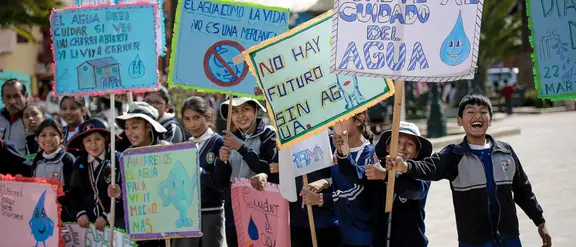
In many countries around the world, children's rights are threatened: poverty, exploitation, and climate change are robbing millions of children of their future prospects. We are committed to ensuring that children's rights are protected, strengthened, and implemented. Through projects and clear political demands, we fight for a life of dignity, for education, and for equal opportunities – because the realization of children's rights must be at the heart of global responsibility. Support us!
Your donation helps!
Projects

Children's rights – facts and figures
Realizing children's rights
Every child has the right to the best possible development, free from cruelty, oppression, exploitation, and social deprivation. But the reality is sobering. In many parts of the world, children's rights are trampled underfoot. Serious injustices such as poverty, hunger, war, and increasingly climate change rob children of the essentials for a healthy upbringing and their future prospects.
The gap between aspiration and reality is vast. Yet at the same time, it is a call to action, a call to act decisively in the best interests of children. This is where Terre des Hommes comes in.
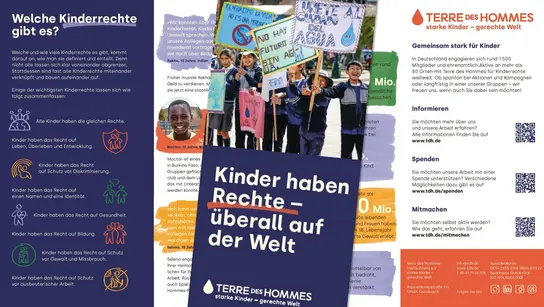
Children's rights? What are those?
The UN Convention on the Rights of the Child
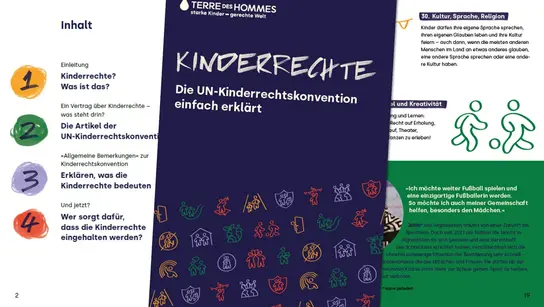
The UN Convention on the Rights of the Child
in simplified language
Read nowThe most important agreement for the protection of children's rights at the international level is the UN Convention on the Rights of the Child of 1989. It specifies general human rights in a way that corresponds to the conditions of children, i.e. their dependencies, their need for protection and support, but also their developing abilities.
196 states have ratified the UN Convention on the Rights of the Child, more than any other human rights treaty. The international community has a duty to implement children's rights and to pursue policies that ensure these rights are upheld worldwide, even in the context of globalization. Businesses, too, must recognize their responsibility regarding children's rights, as they influence the lives of billions of children – both positively and negatively.
Full text of the UN Convention on the Rights of the ChildDevelopment opportunities for children
Development based on children's rights is a holistic concept that aims to promote children's abilities, their emotional and social needs, and their physical and mental health. The task of a child rights-based development policy is to create an environment in which all children can develop to their fullest potential and exercise their rights. This requires improving the political, social, economic, cultural, and environmental framework at the local, national, and international levels.
Today, children's development opportunities are extremely unevenly distributed both within and between countries. Many children are disadvantaged in their access to education and other forms of basic services due to their background or gender. Whether a child lives in poverty or is threatened by climate change often depends on where they are born. The policies and economics of wealthy countries severely restrict the development opportunities of people in poorer countries.
Young people are almost always excluded from development policy decisions that affect them. They are increasingly frustrated by the inadequate political response to climate change and other current and future challenges.
Demands for children's rights
- …to enshrine children's rights in the Basic Law.
- …to strengthen the social infrastructure for all children and young people in Germany and to involve them in solving important future issues.
- …to support the integration of young refugees through adequate housing conditions, opportunities for family reunification and access to fair asylum procedures in Europe.
- …an appropriate contribution from Germany to the global financing of development, humanitarian aid and climate protection.
- …a development policy initiative for children's rights, so that all children have a fair chance to start life despite many challenges.
- …measures to mitigate climate change, adapt to climate change and address climate damage, in accordance with children's rights.
- …the strengthening of the international human rights system and a foreign policy without double standards that consistently addresses human rights violations and violations of international humanitarian law.
- A legally compliant and ambitious implementation of the EU Supply Chain Directive (CSDD) and the Supply Chain Act (LkSG) without lowering the existing level of protection. In particular, forced and exploitative child labor must be consistently combatted.
- a UN agreement on business and human rights to shape globalization in accordance with human and children's rights.
- …to strengthen civil society as a key pillar in promoting children's rights, democracy and development.
- …to protect defenders of children's rights from state or non-state defamation, criminalization and persecution.
- …to create a safe and supportive environment in which children’s contribution to ecological sustainability, justice and peace is recognized and supported as civic and political engagement.
Your contact person

Jonas Schubert
Speaker Advocacy