

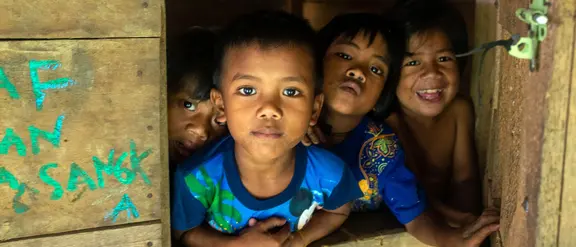
Indonesia: A school for indigenous children
When Begarak (10 years old) and Ngusor (12) read, write and do arithmetic, their flashlights are never far away: their lessons usually begin when the sun gradually sets over Sumatra.
The two boys belong to the indigenous group of the "Orang Rimba," the "people of the jungle" in Indonesia. That the children of this community can attend school is not a given. During the day, they have to help with field and garden work, and sometimes with gathering or hunting. Some parents don't allow their children to go to school at all, seeing it as an obstacle to their daily tasks. However, more and more families are understanding how important education is—not only for the children, but also for the preservation of their entire culture and way of life.
“We Orang Rimba still lack recognition from people outside our community,” reports Melak, 20 years old. “Some call us ‘Orang Kubu’ to mock us.” In Malay, “kubu” has a negative meaning, like “primitive” or “stupid.” The Orang Rimba live in the Indonesian jungle, far removed from modern life, moving from place to place and generally lacking formal education. This makes them vulnerable: Outsiders encroach on their ancestral forests, cutting them down and establishing palm oil plantations. Orang Rimba are repeatedly attacked, displaced, and injured. Many don’t know how to defend themselves, something that could be achieved through laws protecting traditional communities. “But we are all the same. The jungle communities have their own customs, just as people outside the jungle have their customs,” says Melak.
Education helps children to assert their rights
For him, education is the key to speaking to outsiders on equal terms and being respected by them. He himself has already had the opportunity to go to school: in 2005 terre des hommes and its local partner organization, Sokola, opened the Sokola Rimba ("Jungle School"). Melak started school at the age of ten. Today, ten years later, he teaches there himself. The school has made it possible for many children to learn to read, write, and do arithmetic without having to give up their homeland and their identity. Lessons are taught in their own language, in a way that corresponds to the teaching and learning methods of their culture.
Melak is aware that the rights of the Orang Rimba children are far from being fully realized. But at least, thanks to the Sokola Rimba, they now know these rights and how to protect themselves – legally – against land grabbers. And they have entirely new opportunities to forge their own paths. "I actually wanted to become a police officer. My father even gave me his blessing," says Melak. But for now, he has chosen a different path, because: "If I become a police officer, I wouldn't be able to teach the children here anymore."