

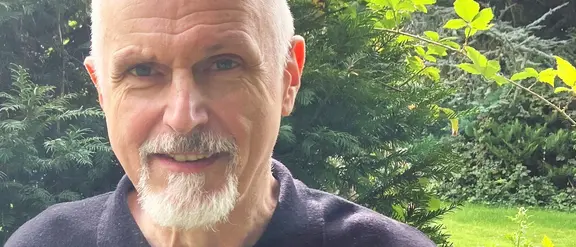
Presidential Board has a new chairman
Udo Hentrich holds a doctorate in political science and worked as a teacher at a vocational college in the Rhein-Kreis Neuss district until his retirement in early 2025. He was also actively involved in the Workers' Welfare Association (AWO) in the Ruhr region for many years, holding various positions. At the members' meeting in September, he was elected the new chairman of the Presidential Board . Staff member Sandra Fenkl spoke with him there about his motivation and the goals of his work in his new role.
Sandra Fenkl: Udo, my warmest congratulations on your new position. It's been a long journey from my first contact with Terre des Hommes to today, hasn't it?
Udo Hentrich: Yes, I've known Terre des Hommes since my university days, but my professional commitments didn't leave me time to get involved; I limited myself to donating. Four years ago, I met the Neuss/Düsseldorf group and joined. Wonderful friendships developed from that. Last year, the spokesperson for our group inspired me to run for the Presidential Board of Terre des Hommes . I'm very pleased that, after a year on the Presidential Board , I've now been elected chairman. In these increasingly challenging times, I want to work with the volunteers and staff to make a real difference for children and further advance Terre des Hommes
what distinguishes Terre des Hommes from other non-profit organizations?
Terre des Hommes is a grassroots movement. No one is bound by rigid club rules; the groups are autonomous and can freely implement their ideas and activities. Some organize art auctions, quiz nights, and bazaars; others speak directly with politicians in their constituencies, give lectures at schools or adult education centers, design exhibitions in libraries or adult education centers, initiate information booths and action days, while still others knit socks and sell them at the Christmas market. A colorful kaleidoscope of diverse activities. It's simply fantastic! Alongside my new position, I remain active in the Neuss/Düsseldorf group and am delighted by our diverse commitment to children, such as supporting the children's rights team in Neuss.
What are the biggest challenges for Terre des Hommes against the backdrop of increasing political, social, and economic changes?
Significant shifts have occurred in these areas. Traditional structures and majorities in politics are dissolving, and trust in politics and civil society organizations is waning. We need to explore how we can still win people over to our cause. A first step is: We should communicate our successes – and there are many – better. More people should know that our project work is effective and that we can truly improve the world for children – whether as donors or through volunteer work.
What priorities will you set in your role?
A crucial and central aspect for me is strengthening children's rights. This begins with raising public awareness of the issue. Terre des Hommes currently developing a modern exhibition on children's rights, which will be presented to the public shortly. I will be present with this exhibition at the Central Library in Düsseldorf for International Children's Rights Day. Furthermore, numerous lectures on children's rights are already scheduled for 2026.
Another focus of my work as chairman is promoting democracy in our society. It alarms me to see that anti-democratic and fundamentalist forces are gaining increasing influence in our society. I deeply value our liberal and free democracy and want to contribute through my commitment to ensuring that our children can live in a democracy where freedom, human rights, and children's rights are highly valued and enshrined in law.
A third focus for me is education in a very broad sense. As a former teacher, I see education as the foundation for a self-determined life. At the same time, education is the best protection against questionable ideologies. In the area of school education, there are enormous challenges in Germany, as, for example, more and more young people are leaving school without a diploma. This should not be the case, and something must be done to change it.
"In my professional life I have worked almost exclusively with disadvantaged children and young people and am therefore very happy to be able to get involved with Terre des Hommes in a social organization that advocates for the rights of children."