

Mozambique: Environmental protection during heavy sand mining
Where coconut palms and orange trees still grow, houses stand, and cemeteries lie, a subsidiary of the mining giant Rio Tinto wants to extract heavy mineral sands. The local population is setting conditions – and is being supported by Terre des Hommes .
Luisa Joaquim from Nhalicocoane believes in a better future: "Our children will have jobs, we will get schools and health clinics, running water and electricity," the 53-year-old farmer announces in the village's meeting place under a large cashew tree.
She had heard that the company Mutamba Mineral Sands (MMS) would be responsible for this. MMS is a subsidiary of the British-Australian mining giant Rio Tinto and plans to extract heavy mineral sands on the site where the village of Nhalicocoane currently stands. Specifically: zircon, rutile, and ilmenite, also known as titan iron ore.
The extract will be transported by heavy truck to the port of Maputo, the capital of South Africa, and then shipped via Richards Bay to China. There, the minerals will be used primarily in the production of high-quality paints and porcelain glazes. MMS holds a concession for 25,000 hectares of land approximately 500 kilometers north of Maputo – on the fish-rich and tourist-friendly coast of Inhambane. In the first phase, the company plans to assess the project's viability on 261 hectares.
Thousands of people are affected, because their fields, cemeteries, and villages lie where the sand is to be extracted. Almost all of them live from small-scale farming. They harvest cassava, beans, corn, lettuce, coconuts, mangoes, or oranges and keep a few chickens. The area is poor. Accordingly, expectations for the economic upswing resulting from the heavy sand extraction are high. In Nhalicocoane, the families have clear ideas about the new village to which they are to be resettled.
"We demand that there be electricity, running water, a school and a market there."
“We demand that there be electricity, running water, a school, and a market there,” says Dercia Castro. “If there isn’t any of that, then we won’t move.” The cemeteries with their deceased family members should also be taken along; that’s important to the people of Nhalicocoane. “What I have here, they have to give me there too,” says Dercia.
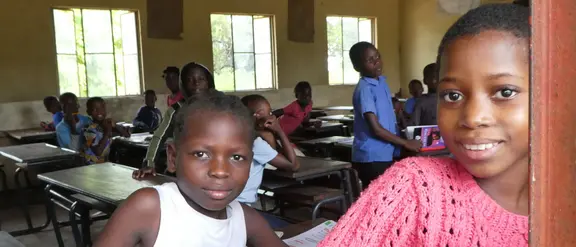
The 24-year-old is a member of the environmental club in Nhalicocoane. It was founded by the organization Kuwuka JDA and, like six other environmental clubs in similarly affected villages, is supported by Terre des Hommes and the German Federal Ministry for Economic Cooperation and Development (BMZ). In these environmental clubs, young people discuss the positive and negative aspects of heavy sand mining, learn about their rights, network, and prepare for the public hearings, which are required by international standards and take place regularly.
“Representatives of the affected village communities do participate in the hearings,” says Zito Covane, who coordinates the Terre des Hommes project and the environmental clubs, “but they are not adequately informed and cannot truly contribute. Technical jargon is used that they cannot understand. Furthermore, the atmosphere is very intimidating: there are government officials, police, and various experts present. Therefore, it is unlikely that they will speak out critically.” Zito Covane explains to the young people in the environmental clubs, in particular, what the hearings are about, what risks heavy sand mining entails, and what their rights are. He encourages them to participate and fight for their interests and those of the village. When the project begins, they should be able to remind Terre des Hommes of its promises.
"We shouldn't accept everything that's done to us."
“Kuwuka JDA stands by the village community,” says Julião Sikisse, the village chief of Nhalicocoane. “They help us see what is good and what is not. We shouldn’t accept everything that is done to us and shouldn’t say yes to everything. What comes next must even be better than what we have now.”
Kuwuka JDA's radio spots, broadcast regularly in the local language Bitonga and in Portuguese, aim to raise awareness and appreciation among village communities, especially young people, about the importance of a healthy environment. The young people are meant to learn to stand up for nature and their rights – both against the company MMS and against government institutions.
When it comes to extracting raw materials, promises are often broken, and the local population all too often has to bear the negative consequences, such as environmental damage, while others reap the profits. Mozambique, which ranks 142nd out of 180 on Transparency International's Corruption Perceptions Index, offers numerous examples of this. Influential politicians from the ruling FRELIMO (Frente de Libertação de Moçambique) party hold stakes in companies and readily turn a blind eye to tax evasion. As a result, the growing resource industry's contribution to Mozambique's state revenue remains far below its potential.
"What good is a job if the environment is destroyed?"
“I was pretty nervous when I spoke up at the hearing in Inhambane,” admits 20-year-old Artur. He, too, belongs to one of the environmental groups; his village is called Madonga. While it is not slated for relocation—at least not in the first phase—it is affected by the foreseeable environmental impacts. Artur fears dust, heavy traffic, accidents, and vibrations that could damage houses and drive snakes toward the village.
No one has yet told the people of Madonga exactly what will happen to their village and their fields. They have only observed that soil samples have been taken in many places. Artur is worried: "No one knows if nature will recover once the area is renaturalized," he points out. He dismisses the main argument of the sand mining proponents, the approximately one hundred jobs expected: "What good is a job if the environment is destroyed? Then I come home and the air is bad. And when I open the window, exhaust fumes, smoke, and noise come in. The environment is more important to me than a job in the mines. I may have less money, but I'll live a healthy life."
MMS still does not have a mining license. The environmental impact assessment, which was commissioned by the company itself, has too many weaknesses and ambiguities even for the FRELIMO government to approve the project. Numerous risks are identified, but the conclusion is nonetheless that sand extraction can begin; it would have more positive than negative effects. The expert denies that this result is a favor to the client: after all, it is possible to repair most of the damage. The fertile topsoil, for example, will be stored for later use when MMS withdraws after 25 years.
Where will the more than 300 people from Nhalicocoane, who are to be resettled in the first phase, be able to go? How high will the compensation be for the destroyed fields and fruit trees? Will the cemeteries be relocated despite the costs? Will complete restoration be possible? Much remains unclear, but preparations for the heavy sand extraction are already in full swing: trees have been felled, there is accommodation for the workers, a doctor, and the so-called Wendelscheider, a spiral chute that uses gravity to separate the mineral sands from the rest of the sand.
The extent to which the hopes of Luisa Joaquim, Dercia Castro, and the other villagers for jobs and a better life will be fulfilled, and to what extent they—like so many before them—will only experience the negative consequences of sand mining while others pocket the profits, depends in part on how well they can negotiate and remind MMS of its promises. The farmer Luisa Joaquim seems determined: "Our expectations aren't unreasonably high," she says. "They are our right. If MMS says NO, we'll say NO too."